Quick Answer
How do real estate agents use AI to respond to inquiries in under 60 seconds?
AI-powered CRM tools respond to incoming inquiries the moment they arrive — day or night — by sending a personalised acknowledgement, asking 2–3 qualifying questions, and alerting the agent once a lead is warm. The result is a sub-60-second first touch that dramatically outperforms the industry average response time of over 15 hours. This matters because leads contacted within 5 minutes are 21 times more likely to qualify than those reached after 30 minutes, per the MIT Lead Response Management Study.
Key Takeaways
- The average real estate agent takes 917 minutes — over 15 hours — to respond to a new lead inquiry, per Inman's 2025 Real Estate Technology Survey. That gap is where deals are lost.
- Leads contacted within 5 minutes are 21x more likely to qualify than those contacted after 30 minutes, per the MIT Lead Response Management Study conducted by Dr. James Oldroyd in partnership with InsideSales.com.
- Responding within one minute increases conversion rates by 391%, according to Velocify research on lead response timing.
- 78% of buyers work with the first agent who responds to their inquiry, per NAR's 2025 Home Buyers and Sellers Generational Trends Report — not the most experienced agent, or the best reviewed.
- Teams using after-hours AI capture 15–20 additional qualified leads per month that would otherwise be completely lost, according to MindStudio's 2026 real estate AI deployment analysis.
- A good AI response must acknowledge the specific inquiry, ask one qualifying question, and confirm next steps — generic auto-replies that say "we'll be in touch" do not stop leads from calling the next agent on the list.
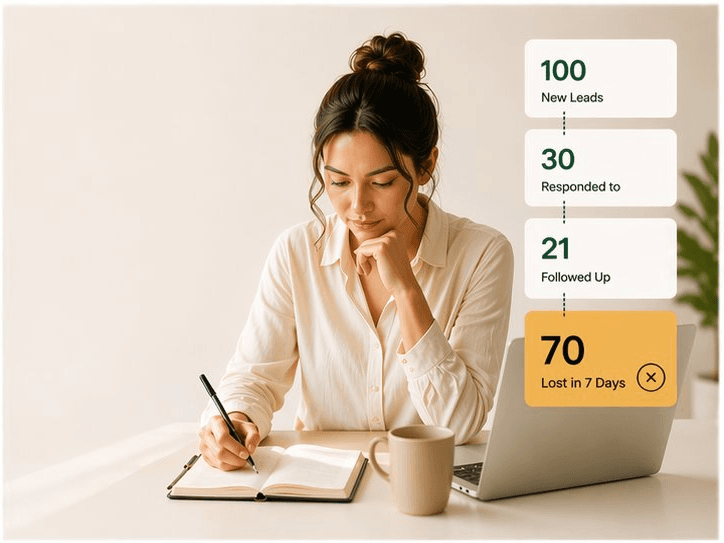
Priya Sharma, a mid-volume agent working Pune's western suburbs, spent ₹18,000 on a Magicbricks lead campaign in January. Of the 34 inquiries that came in, she personally followed up with 9 — the ones she saw before getting pulled into back-to-back showings. Her response time on those 9 averaged four hours. She converted zero of them to appointments. The other 25 inquiries sat in her inbox until the following morning. By then, the prospects had already moved on, either to a competing agent who had responded faster, or to another property entirely. That ₹18,000 campaign returned nothing.
This article shows you exactly how to close that gap using AI: what the response needs to say, how to set up automated qualification so the AI hands you warm leads instead of cold ones, how to handle the moments AI can't answer, and how to test everything before you go live. By the end, you'll have a system that responds to every inquiry in under 60 seconds regardless of whether you're in a meeting, on a showing, or asleep.
Why 60 seconds is the threshold
The speed advantage in real estate isn't about being polite — it's about catching a prospect at the only moment their attention is completely on you. When someone submits an inquiry about a listing, their interest is at its absolute peak. They are mid-decision, not browsing passively. That window is genuinely short.
Stat: Leads contacted within 5 minutes are 21 times more likely to qualify than those contacted after 30 minutes. After 10 minutes, the odds of qualifying that same lead drop by 400%. — MIT Lead Response Management Study, Dr. James Oldroyd / InsideSales.com
The Harvard Business Review lead response study — which analysed 2.24 million sales leads — found that companies responding within one hour were nearly seven times more likely to qualify a lead than those that waited even 60 minutes. Wait 24 hours, and you are 60 times less likely to qualify the lead compared to that first-hour responder.
For real estate specifically, the picture is starker. NAR's 2025 Home Buyers and Sellers Generational Trends Report found that 78% of buyers work with the first agent who responds to their inquiry. This isn't a preference — it's a pattern. Buyers interviewing only one agent before committing is the norm: the 2025 NAR Profile found that 76% of repeat buyers and 67% of first-time buyers never contacted a second agent. If you weren't first, you never got a chance.
The problem is structural, not motivational. The average agent takes 917 minutes to respond to a new lead — over 15 hours — according to Inman's 2025 Real Estate Technology Survey. That's not laziness; it's that inquiries arrive when agents are on showings, in negotiations, or simply offline. A human cannot physically respond within 60 seconds to a lead that arrives at 9 PM on a Friday. AI can. That's the entire argument for automating first response.
What a good AI response looks like
Most automated responses fail not because they are slow, but because they are generic. A message that says "Thank you for your enquiry, we'll get back to you soon" does nothing to stop the lead from submitting the same form to three other agents. A good AI response does three things in one message: it names the specific property or inquiry, it asks one qualifying question, and it confirms what happens next.
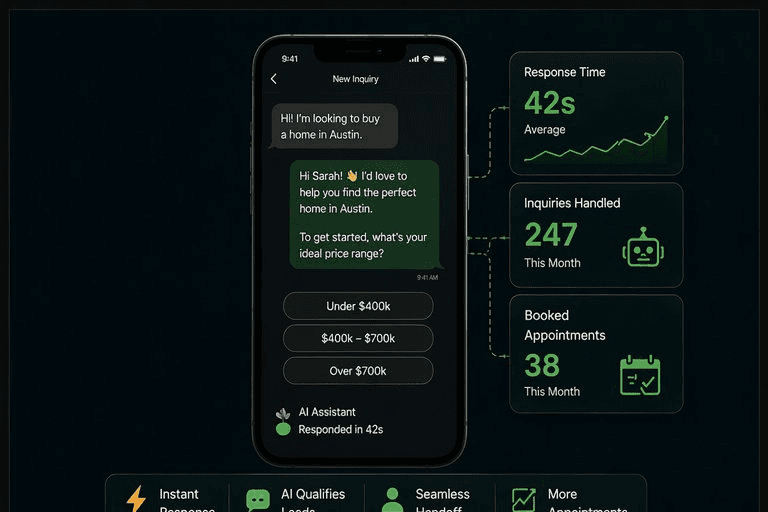
Here is a concrete example of what this looks like via WhatsApp or SMS for a buyer inquiry:
AI Message (sent within 15 seconds of form submission):
Hi [First Name] — thanks for your interest in the 3BHK on MG Road. I'm Amaan's assistant at Pinova Realty. Quick question: are you looking to move within the next 3 months, or are you still in the research phase? Your answer helps me send you the most relevant info straight away.
This message works because it references the specific listing (proving the inquiry was received and read), asks a single binary question (low effort for the lead to answer), and frames the answer as being in the lead's interest. It does not push for a call immediately, which can feel aggressive before rapport is established.
For seller inquiries requesting a valuation, the same principle applies but with a different qualifying question:
AI Message — Seller Valuation Request:
Hi [First Name] — just received your request for a valuation of your property in [Area]. To give you an accurate number, one quick question: are you thinking of selling in the next 6 months, or is this more for future planning? That shapes what comparables I pull.
The consequence of sending a generic "we'll be in touch" response instead: the lead has no reason to wait. They're already on Magicbricks, Housing.com, or 99acres — the next agent listing is one click away. A specific, question-based response creates a micro-commitment: the lead has now engaged, which increases the probability they'll wait for your follow-up rather than moving on.
Stat: Responding within one minute increases lead conversion rates by 391%. — Velocify Lead Response Optimisation Research
The channel matters too. WhatsApp and SMS outperform email for real estate leads because they're read immediately — the average WhatsApp message is read within 3 minutes of receipt. Email inboxes require the lead to actively check them, which adds unpredictable delay. Configure your AI to default to WhatsApp or SMS first, with email as a fallback if no mobile number was submitted.
Setting up AI response in Pinova
Pinova's AI Lead Response feature works by connecting directly to your lead sources — Magicbricks, 99acres, Housing.com, and your website contact form — and triggering a personalised response the moment an inquiry is received, regardless of the time or day. The system pulls the lead's name, the property they enquired about, and their contact channel, then constructs a message using a response template you configure once. You set the qualifying questions (up to three, asked sequentially based on the lead's replies), the message tone, and the escalation trigger — meaning the point at which the AI flags the conversation to you as warm.
Once a lead responds to the AI's qualifying question, Pinova scores the lead based on their answer (timeline, pre-approval status, or seller motivation) and adds them to a priority queue in your CRM dashboard. You get a push notification with the full conversation summary, the lead's qualifying score, and a one-tap option to call or WhatsApp them directly. The AI does not attempt to close the appointment — that step is yours. What it delivers to you is a lead who has already identified their timeline, is expecting your call, and has been kept engaged while you were unavailable.
Teams using AI after-hours capture 15–20 additional qualified leads per month that would otherwise be lost entirely — leads that submitted inquiries between 8 PM and 8 AM when no human was monitoring the inbox, according to MindStudio's 2026 real estate AI deployment analysis. At an average commission of ₹75,000 per closed deal, even converting two additional leads per month from that after-hours pool represents ₹1,50,000 in recovered revenue that previously went to competitors who had faster systems.
The 3 qualifying questions AI should ask
Not every lead deserves the same urgency. A buyer who wants to move within 90 days and is pre-approved needs your personal attention within minutes of their first reply. A buyer "just exploring options" for a purchase 18 months away belongs in a long-term nurture sequence. The AI's qualifying questions are the filter that separates these two groups before you invest your time.
Ask these three questions sequentially — one per message, not all at once. A list of three questions in one message feels like a form, not a conversation, and reply rates drop significantly.
| Key Statistic / Finding | Source & Year |
|---|---|
| Qualifying Question 1 — Timeline: 'Are you looking to move/sell in the next 3 months, or are you still in the early research phase?' Anything under 90 days = immediate priority. | Best practice — speed-to-lead qualification |
| Qualifying Question 2 — Financing (buyers) / Motivation (sellers): 'Have you spoken to a lender yet?' or 'Is there a specific reason you're considering selling now?' Pre-approved buyers close 3x faster. | NAR 2024 buyer/seller data |
| Qualifying Question 3 — Specifics: 'What's the most important thing for you in a property — location, size, budget, or something else?' Lets you personalise the next message and decide if you're the right agent. | Lead qualification best practice |
After collecting these three answers, your AI should pass a summary to the CRM and stop asking questions. The common mistake is building an AI that continues the conversation indefinitely — asking about preferred areas, budget ranges, specific amenities — until the lead feels interrogated and stops responding. Three qualifying questions is the limit for an automated conversation before a human should take over.
If a lead doesn't reply to the first qualifying question within 4 hours, the AI should send one follow-up: "Just checking you got my earlier message — happy to answer any questions about [property/valuation] when you're ready." That's the entire follow-up sequence for non-responders at the AI stage. Anything more aggressive increases opt-out rates without improving conversion.
How the handoff to you works
The handoff is the moment that determines whether the AI system actually earns you business or just creates the impression of responsiveness. A bad handoff — where the agent calls the lead cold, unaware of what the AI already discussed — undoes all the goodwill the fast response created. A good handoff means you pick up the phone already knowing the lead's name, what they enquired about, their timeline, their financing status, and what they said in their own words.
The mechanics of a clean handoff in a well-configured AI system work like this: once the lead completes the qualifying sequence, the CRM generates a one-screen summary card that includes the lead's name and contact number, the property or request that triggered the inquiry, a verbatim transcript of the AI conversation, the qualifying score (hot/warm/cold) based on the answers given, and the recommended next action (call now, schedule for tomorrow, add to nurture). You receive a push notification with this card and a one-tap dial button.
When you call, open with the summary, not a re-introduction: "Hi [Name] — I saw you're looking at the MG Road property and hoping to move in the next two months. I wanted to call personally because properties in that area are moving fast and I'd like to get you in for a viewing before the weekend. Does Thursday or Friday work for you?" This approach — referencing what they already told the AI — signals that you actually read their answers, which creates immediate trust and skips 3–4 minutes of re-qualification you'd otherwise have to do on the call.
Stat: 80% of sales require five or more follow-up contacts after the initial inquiry. Yet 44% of agents give up after just one follow-up. — National Sales Executive Association / Inman, 2025
For leads that don't answer your call after the handoff, have your AI system automatically trigger a follow-up SMS two hours later: "Hi [Name] — tried calling you just now. I'm Amaan from Pinova Realty, following up on the [Property] you enquired about. Happy to answer any questions by WhatsApp if that's easier." Leads that received six or more contact attempts convert at rates 70% higher than those who receive fewer touches, per Real Trends research — so persistence at this stage is disproportionately valuable.
Edge cases: what happens if AI can't answer
AI response systems fail in predictable, manageable ways. Knowing these failure modes in advance lets you build fallbacks that protect the lead relationship rather than destroy it.
The lead asks a specific property question the AI can't answer. A prospect replies with "Does the flat on MG Road have a covered car park?" If your AI isn't trained on that listing's details, it will either hallucinate an answer (dangerous) or give a vague non-answer (trust-destroying). The correct fallback: the AI responds, "Great question — that's one I want to confirm directly for you. I'll have the agent call you within the hour with the exact details." The inquiry is immediately escalated to you as urgent. You call, answer the question, and the lead is impressed by the personalised follow-through.
The lead wants to speak to a human immediately. Any message containing "I want to speak to someone," "call me," or "is anyone there" should trigger an immediate human escalation alert, bypassing the qualifying sequence entirely. Configure this as a keyword trigger in your AI settings. Forcing a lead who explicitly wants human contact through an automated flow is one of the fastest ways to lose them.
The inquiry arrives in a language your AI isn't trained on. In Indian real estate markets, this is common — Hindi, Marathi, Telugu, or Kannada inquiries arrive on English-language portals. If your AI can't respond in the lead's language, it should send a bilingual acknowledgement: the first line in your AI's configured language, the second line reading "हम आपसे जल्द संपर्क करेंगे" (We will contact you shortly) or the relevant regional equivalent — and escalate immediately. A language-matched human follow-up within 15 minutes converts these leads at disproportionately high rates because most competitors won't make the effort.
The lead goes silent mid-conversation. If a lead answers the first qualifying question and then doesn't reply to the second, send one SMS nudge 24 hours later: "Still happy to help with [property/valuation] when the time is right for you — just drop me a message." After that, move them into a monthly check-in nurture. Do not send more than two follow-up attempts when the AI conversation stalls; the lead is not ready yet, and over-messaging damages your number's deliverability with WhatsApp and SMS carriers.
How to test your setup before going live
Going live without testing is how agents end up sending garbled messages to real prospects. Run this five-step test before switching your AI response system on for live inquiries.
Step 1: Submit a test inquiry from your own phone. Use your personal mobile number — not your agent number — and submit a contact form or portal inquiry exactly as a lead would. Time how long it takes for the AI response to arrive. It should be under 30 seconds. If it takes longer than 60 seconds, your integration with the lead source has a delay you need to fix before going live.
Step 2: Reply to the AI's first message with the name of a property detail you haven't configured. Type something like "Does it have a terrace?" or "Is parking included?" and see how the AI handles an out-of-scope question. If it gives a confident but wrong answer, you need to add a fallback escalation trigger before going live.
Step 3: Reply "I want to speak to someone." Confirm that this triggers an immediate human escalation notification to your phone. If the AI continues the qualifying sequence instead of escalating, fix the keyword trigger.
Step 4: Don't reply to the AI's first message for 5 hours. Confirm that only one follow-up is sent during this time, and that it matches the non-aggressive copy you configured. If you receive multiple follow-ups, your drip frequency settings need adjustment.
Step 5: Complete the full qualifying sequence and confirm the handoff. Answer all three qualifying questions, then check that your CRM dashboard shows the full conversation transcript, a lead score, and a push notification on your agent phone. Call the test number back using the one-tap dial feature and confirm the call connects cleanly. If any step in this chain fails, the handoff will fail with real leads too.
Key Statistics: Lead Response Time & AI in Real Estate
| Key Statistic / Finding | Source & Year |
|---|---|
| Leads contacted within 5 minutes are 21x more likely to qualify than those contacted after 30 minutes | MIT Lead Response Management Study, Dr. James Oldroyd / InsideSales.com |
| Companies responding within 1 hour are 7x more likely to qualify a lead; waiting 24 hours makes them 60x less likely | Harvard Business Review Lead Response Study, 2.24 million leads |
| Responding within 1 minute increases lead conversion rates by 391% | Velocify Lead Response Optimisation Research |
| 78% of buyers work with the first agent who responds to their inquiry | NAR 2025 Home Buyers and Sellers Generational Trends Report |
| The average real estate agent takes 917 minutes (over 15 hours) to respond to a new lead | Inman 2025 Real Estate Technology Survey |
| 80% of sales require 5 or more follow-up contacts; 44% of agents give up after just 1 | National Sales Executive Association / Inman, 2025 |
| Leads receiving 6 or more contact attempts convert at rates 70% higher than those with fewer touches | Real Trends Lead Conversion Research |
| Teams using after-hours AI capture 15-20 additional qualified leads per month that would otherwise be lost | MindStudio Real Estate AI Deployment Analysis, 2026 |
| 88% of home buyers purchased their home through a real estate agent or broker in 2025 | NAR 2025 Profile of Home Buyers and Sellers |
| 76% of repeat buyers and 67% of first-time buyers interviewed only one agent before committing | NAR 2025 Profile of Home Buyers and Sellers |
| Only 27% of leads are ever contacted across industries; 73% are lost due to slow or absent follow-up | Forbes / InsideSales.com Secret Shopper Studies |
| Catching a prospect while still on your website increases engagement rate by over 300% | Callingly Real Estate Lead Response Study |
Ready to put this into practice?
Pinova gives you the website, AI, CRM, and follow-up in one platform — live in 48 hours, no credit card required.
Start Your Free Trial
Frequently Asked Questions
How quickly do I need to respond to a real estate inquiry to win the lead?
Within 5 minutes gives you a 21x qualification advantage over responding at the 30-minute mark, per the MIT Lead Response Management Study. Responding within 1 minute increases conversion rates by 391% according to Velocify research. For practical purposes, your goal should be a sub-60-second automated first response with a human follow-up call within 15–30 minutes once the lead has replied to your qualifying questions.
What should an AI response say to a real estate inquiry?
An effective AI response does three things: it names the specific property or request the lead submitted (proving their message was received), asks one qualifying question about timeline or motivation, and tells the lead what happens next. Avoid generic acknowledgements like "we'll be in touch" — they give the lead no reason to wait for you rather than submitting the same inquiry to a competing agent.
Can AI qualify real estate leads without a human agent?
Yes, for the initial qualification stage. AI can reliably ask 2–3 sequential questions covering timeline, financing status, and property preferences, then score the lead and pass a warm handoff to the agent. What AI cannot do is negotiate, handle complex objections, or build the personal rapport needed to convert a lead into a signed client — those steps require a human.
What are the 3 most important qualifying questions to ask a real estate lead?
Ask about timeline first (are they looking to move or sell within 90 days or still in early research?), then financing or motivation (are they pre-approved, or what's prompting the sale?), and finally their primary priority (location, budget, size, or something specific). Ask these one at a time in separate messages, not as a list. A list of three questions in one message feels like a form and reduces reply rates significantly.
What happens when a real estate lead asks something the AI can't answer?
Configure your AI with a specific fallback for out-of-scope questions: the AI acknowledges the question, confirms it needs to check with the agent, and escalates the conversation to you immediately as urgent. It then sends the lead a message saying the agent will call within a specific timeframe. Never let the AI guess at property details — a confident wrong answer is worse than an honest "let me check and get back to you."
How many follow-up messages should AI send if a lead doesn't respond?
One follow-up, sent 4 hours after the first message goes unanswered. If the lead doesn't reply to that either, move them into a monthly check-in nurture sequence. Sending more than two automated messages to a non-responding lead at the AI stage increases opt-out rates and can get your number flagged by WhatsApp as spam, which damages your delivery rates for all leads.
How do I hand off a qualified lead from AI to myself without it feeling awkward?
Reference the AI conversation directly when you call. Say something like: "Hi [Name] — I saw you enquired about the [Property] and mentioned you're hoping to move within the next two months. I wanted to call personally because that area is moving quickly." This demonstrates you actually read their answers, which immediately builds trust and lets you skip the re-qualification you'd otherwise do at the top of the call. The AI conversation transcript should be visible on your CRM screen before you dial.
Is it worth setting up AI responses for after-hours real estate inquiries?
Yes — and the data is specific. Teams using after-hours AI capture 15–20 additional qualified leads per month that would be completely missed without automation, according to MindStudio's 2026 real estate AI analysis. Many online real estate inquiries are submitted in the evening when prospects are browsing listings after work. An agent without after-hours response coverage loses every one of those leads to whoever responds first.