Quick Answer
How do I get my real estate website to show up in Google AI Overviews?
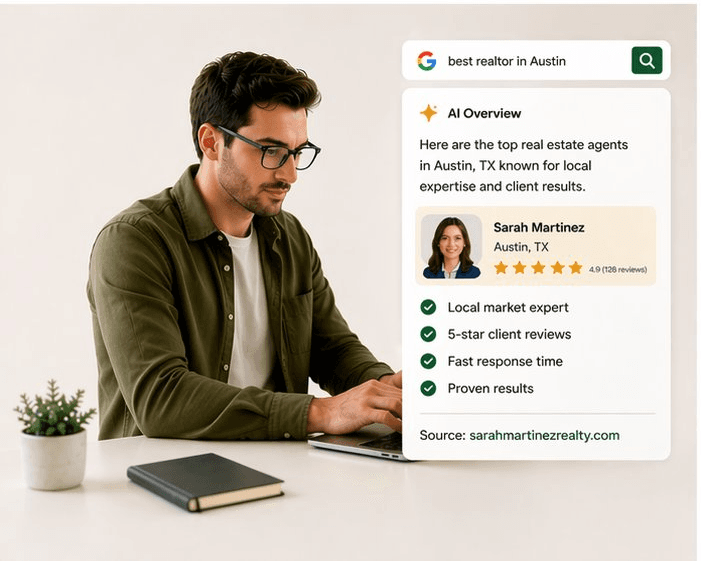
Google AI Overviews appear in only 5.8% of real estate queries, per Ahrefs' November 2025 analysis of 55.8 million AI Overviews—far lower than other industries because local and transactional searches are satisfied by map packs and listing results instead. The real estate queries that do trigger AI Overviews are almost exclusively informational: neighborhood guides, buying process questions, and market explainers. To earn a citation, your site needs: pages that rank in the top 10 for those informational queries (76.1% of all AI Overview citations come from top-10 pages per Ahrefs' July 2025 study), JSON-LD structured data using Article and FAQPage schema with a real author name and dateModified field, Core Web Vitals scores in the "Good" range (LCP under 2.5 seconds), and hyperlocal content that covers a topic cluster—not a single page. Sites cited in AI Overviews earn 35% higher organic CTR than uncited competitors on the same queries, per Seer Interactive's September 2025 study of 25.1 million impressions.
Key Takeaways
- Google AI Overviews appear in only 5.8% of real estate queries—far below the cross-industry average of 15.69%—because local and transactional searches are served by map packs and listing features instead, per Ahrefs' November 2025 analysis of 55.8 million AI Overviews.
- Sites cited in Google AI Overviews earn 35% higher organic CTR and 91% higher paid CTR than uncited competitors on the same queries, per Seer Interactive's September 2025 study of 3,119 queries across 42 organizations.
- 76.1% of URLs cited in AI Overviews also ranked in Google's top 10 organic results, per Ahrefs' July 2025 study of 1.9 million citations—meaning ranking on page one remains the primary prerequisite for AI Overview visibility.
- JSON-LD structured data is the highest-leverage technical change: a Search Engine Land controlled experiment in September 2025 found that only the page with well-implemented schema appeared in a Google AI Overview when three near-identical pages competed for the same query.
- Over 72% of geo-specified buyer conversations reference a named neighborhood or exact address rather than a city or metro area, per Realty AI's 2025 State of Real Estate Conversations Report—making neighborhood-level content the primary surface for real estate AI Overview citations.
Priya Mehta, an agent in Austin, Texas, published a single neighborhood guide targeting "Barton Hills Austin first-time buyers" in November 2024. It took four hours to write, cost nothing in ads, and answered five questions she heard from buyers every week. By October 2025, that one page had generated 43 inbound leads and three closed transactions—roughly $42,000 in gross commission. More importantly, it began appearing in Google AI Overview citations for related neighborhood questions, which sent traffic that converted at a measurably higher rate than her portal leads. She did not pay an SEO agency. She followed a repeatable structure that any agent can apply to any neighborhood they serve.
This article explains how Google AI Overviews actually work in real estate (with accurate numbers, not inflated ones), what your website needs technically and structurally to earn citations, how to write the content that gets pulled into AI answers, and what a realistic 30-day optimization plan looks like starting from zero.
How Google AI Overviews decide who to feature
The first thing to correct is the claim, repeated widely in real estate marketing content, that AI Overviews appear on "40%+" of real estate queries. The actual figure is 5.8%, per Ahrefs' November 2025 analysis of 55.8 million AI Overviews across 590 million searches. Real estate is one of the lowest AI Overview penetration verticals—below the cross-industry average of 15.69%—because high-intent real estate searches are satisfied by map packs, local listing features, and direct portal results that Google serves instead. If you are optimizing your real estate website based on that 40% figure, you are solving for a problem that does not exist at scale.
What does trigger AI Overviews in real estate is the informational layer: neighborhood guides, buying and selling process questions, market explainers, and comparisons. Queries like "what are the best neighborhoods in Austin for families," "how long does it take to close on a house in Texas," or "what is a buyer's agent fee" consistently trigger AI summaries. Queries like "homes for sale in Austin 78704" do not—Google serves those with listings and a map pack.
Stat: Google AI Overviews appear in only 5.8% of real estate queries—among the lowest of any industry. Science (43.6%), Health (43.0%), and Pets & Animals (36.8%) lead all verticals. — Ahrefs, November 2025 analysis of 55.8 million AI Overviews
Understanding this matters because it tells you where to invest. Your highest-value optimization targets are not your listing pages or your homepage—Google's AI doesn't typically pull from those. Your targets are your neighborhood guides, your market update blog posts, your "how to buy a home in [city]" pages, and your FAQ content. Those are the pages that qualify for citation, and the traffic those citations send converts significantly better than average. Seer Interactive's September 2025 study of 3,119 queries across 42 organizations found that brands cited in AI Overviews earn 35% higher organic CTR and 91% higher paid CTR than uncited competitors on the same queries—meaning the minority of your real estate content that does get cited punches well above its weight.
The mechanism by which AI Overviews select sources is primarily traditional SEO authority: Ahrefs' July 2025 study of 1.9 million citations found that 76.1% of URLs cited in AI Overviews also ranked in Google's top 10 organic results for the same query. Ranking on page one is still the primary prerequisite. You cannot optimize specifically for AI Overview inclusion without first earning a top-10 organic ranking on the informational query—and the same signals that win that ranking (topical depth, E-E-A-T, page quality, structured data, backlinks) are what earns the citation.
Structured data: the non-negotiable
Structured data has shifted from a rich-result enhancement to a citation-extraction signal. A Search Engine Land controlled experiment in September 2025 placed three near-identical pages competing for the same query—same content quality, same keyword difficulty. The only meaningful variable was schema markup. Only the page with well-implemented JSON-LD appeared in a Google AI Overview. The page with no schema was never indexed. That experiment represents the clearest available evidence that structured data is now a functional prerequisite for AI Overview eligibility, not just a conversion rate optimization.
For a real estate agent website in 2026, implement these five schema types in the following priority order, all in JSON-LD format delivered in the document head—not Microdata, not RDFa:
1. RealEstateAgent (Person or Organization schema). This is your entity schema—it tells Google's Knowledge Graph who you are, where you operate, and what you are known for. Include your license number, the areaServed field populated with every neighborhood you work in by name (not just the city), and SameAs identifiers pointing to your LinkedIn profile, Google Business Profile URL, and NAR member directory listing. Without entity schema, Google's AI cannot confidently resolve your identity as a real estate professional, which reduces your citation probability.
2. Article / BlogPosting schema on every neighborhood guide and market update post. The critical fields: headline, datePublished, dateModified (update this every time you refresh the content—AI engines show a strong recency bias, and Seer Interactive's October 2025 data found 65% of AI bot hits target content published in the past year), author with your real name and profile URL, publisher with your brokerage name and logo, and articleSection matching the neighborhood or topic the page covers.
3. FAQPage schema on any page answering common buyer or seller questions. Google's March 2026 core update narrowed FAQ rich result eligibility, but FAQPage schema remains valuable as an AI trust signal and citation extraction guide even when it no longer triggers a visible SERP feature. Structure each Q&A pair with a question of 8 words or fewer and an answer of 40–70 words that is self-contained—the AI Overview can pull this block directly without context from the surrounding page.
4. LocalBusiness schema on your homepage and contact page, with consistent NAP (name, address, phone) exactly matching your Google Business Profile. Even a formatting difference—"St." versus "Street"—can break entity disambiguation across Google's systems.
5. BreadcrumbList schema on every page to give AI systems a clear content hierarchy signal—this helps the AI understand that your "Barton Hills neighborhood guide" is part of your "Austin real estate" topical cluster, which increases the probability of citation when the cluster topic is queried.
Content requirements for AI indexing
The content that earns AI Overview citations in real estate shares four structural features. Understanding these features matters because writing content that happens to have them is not the same as writing generic SEO content that may rank but not get cited.
Neighborhood specificity, not city-level generalism. Realty AI's 2025 State of Real Estate Conversations Report analyzed buyer conversations and found that over 72% of geo-specified queries reference either an exact address (38.8%) or a named neighborhood (33.4%)—not a city, metro area, or zip code. A page targeting "Austin real estate" competes with Zillow and Redfin and will not rank in the top 10. A page targeting "Barton Hills Austin first-time buyer guide" faces meaningfully less competition and matches how buyers actually search. Each neighborhood you serve should have its own dedicated page—not a section of a combined page—covering at minimum: current median price and days on market with a source and date, school district information with specific school names, commute profiles to the area's major employers, walkability and amenity highlights, and a section answering the three to five questions buyers consistently ask you about that neighborhood.
Sourced, dated statistics. AI systems are built to cite numbers with attribution, not opinions without one. "According to Austin Board of Realtors data from Q1 2026, median days on market in 78746 dropped from 34 to 18 days year over year" is the type of sentence that gets extracted into an AI answer. "The market is moving fast" does not. Every neighborhood page should include three to five current statistics with a named source and a specific date. Update them quarterly—the dateModified field in your Article schema needs to reflect those updates, and freshness is a measurable citation factor.
A self-contained answer in the first 100 words. AI systems extract the most citable passage from a page without requiring the surrounding context. Open every neighborhood guide and FAQ answer with a direct response to the implied question in the title, written as if it were the only thing the reader would see. Realty AI's guidance on AI-cited content notes that listicles with specific ranking rationale—"Barton Hills ranks second because it's one of the few Austin neighborhoods where a buyer under $600,000 can still find a 3-bedroom on a mature lot within walking distance of an elementary school"—consistently get pulled into AI responses. The specificity is the citation trigger.
Topical clusters, not isolated pages. A single neighborhood guide is unlikely to earn a citation on its own. A hub of interconnected content—a central neighborhood guide linking to a school district deep-dive, a commute analysis, a market trends post, and a "homes under $X in [neighborhood]" page—signals to Google that you are a topic authority rather than a one-time publisher. The AI Overview citation research consistently shows that topically deep sites outperform narrow ones even when a narrow page has a higher individual ranking position.
Author signals. Google's E-E-A-T (Experience, Expertise, Authoritativeness, Trustworthiness) guidelines apply directly to AI citation eligibility. Every content page should have a named author with a real bio, a headshot, a link to their Google Business Profile, and mention of their license and transaction history. "Written by [Agent Name], licensed Texas REALTOR® with 12 years and 340 transactions in the Austin market" is a citation-quality authority signal. A byline of "Pinova Team" is not.
Technical website checklist
Technical quality is the floor, not the ceiling. You will not earn AI Overview citations with poor technical fundamentals—but fixing technical issues alone without content quality and structured data will not earn them either. Run through this checklist in sequence.
Core Web Vitals: "Good" threshold across all three metrics. Google has confirmed Core Web Vitals are a ranking signal, used as a tiebreaker between pages with comparable content quality. The official thresholds per Google Search Central (updated December 2025): Largest Contentful Paint (LCP) under 2.5 seconds, Interaction to Next Paint (INP) under 200 milliseconds, Cumulative Layout Shift (CLS) under 0.1. For real estate websites, LCP is typically the failing metric—high-resolution listing photos loaded without compression or lazy loading are the most common cause. Convert images to WebP format, implement lazy loading, and use a CDN. AI systems have tight crawl timeouts of 1–5 seconds; a page that takes 4 seconds to load risks being dropped from citation consideration entirely.
Mobile-first indexing compliance. Google uses the mobile version of pages for indexing and ranking. Over 62% of organic search traffic comes from mobile devices, per SearchAtlas data. Your IDX listings, neighborhood guides, and FAQ pages must render correctly at 375px width without horizontal scrolling, with tap targets spaced at least 8px apart. A responsive layout that merely scales down desktop content is not the same as a mobile-first design.
HTTPS on every page, including IDX subdomains. Any mixed-content warnings—IDX frames loading over HTTP on an HTTPS site—will suppress your page experience signals across the entire domain.
GPTBot and Google-Extended not blocked in robots.txt. If your robots.txt file blocks AI crawler agents, you will not appear in AI Overview citations regardless of content quality. Audit your robots.txt and verify that User-agent: GPTBot, User-agent: Google-Extended, and User-agent: anthropic-ai are not disallowed. Some IDX platform configurations add blanket crawler blocks by default—check specifically for this.
Internal linking that builds topical clusters. Every neighborhood guide should link to at least two other pages in the same topical cluster and receive links from the relevant city or area hub page. Google's AI Overview citation research at Ahrefs showed that pages cited beyond the top 10 often appear for fewer keywords and shorter queries—indicating that cluster coherence, not just individual page ranking, drives citation selection for topic-adjacent queries.
Google Business Profile completeness and NAP consistency. Your Google Business Profile is a direct input into Google's entity resolution for local real estate queries. Complete every field: service area by specific neighborhood names (not just city), business hours, photo uploads updated at least quarterly, and a minimum of 10 Google reviews with responses. NAP on your website, your GBP, and every directory listing must match exactly—including punctuation in the street address.
Why Pinova websites are built for this
Pinova IDX websites ship with JSON-LD structured data pre-configured for RealEstateAgent, LocalBusiness, and Article schema on every page type—including auto-populated dateModified fields that update each time the agent edits or refreshes a page, Core Web Vitals-optimized image delivery using WebP with lazy loading on all listing and neighborhood pages, and robots.txt configurations that allow GPTBot, Google-Extended, and Anthropic's crawler by default rather than blocking them.
Your 30-day optimisation plan
This plan assumes you have a functioning real estate website and are starting from zero on AI Overview optimization. Do not skip to week 3—the steps build on each other.
Week 1: Technical audit and structured data. Run your site through Google Search Console's Core Web Vitals report and PageSpeed Insights. Flag any pages with LCP above 2.5 seconds—for most real estate sites, this will be listing pages with unoptimized photos. Fix the largest files first using WebP conversion and lazy loading. Then audit your robots.txt for AI crawler blocks and remove them. Finally, implement or audit your JSON-LD: verify RealEstateAgent schema on your homepage, Article schema on every blog post or neighborhood guide, and FAQPage schema on any Q&A content. Use Google's Rich Results Test to validate each implementation before moving forward.
Week 2: Identify your top 5 informational queries. Open Google Search Console and filter your queries by "Impressions" over the last 90 days. Find the five informational queries (how-to, what is, neighborhood comparisons, market questions) where you have impressions but a click-through rate below 3%—these are pages where an AI Overview may already be suppressing clicks. Then use Google's "People Also Ask" boxes on those queries to identify the sub-questions AI Overviews are answering. Those sub-questions become your FAQ schema targets and your content refresh priorities.
Week 3: Write or rewrite your top neighborhood guide. Pick the single neighborhood you are most associated with—the one where you have the most transactions and the deepest local knowledge. Write or rewrite its dedicated page to at least 1,500 words following the four structural features described above: neighborhood-level specificity, sourced statistics with dates, a self-contained answer in the first 100 words, and internal links to at least two related pages. Add Article schema with your name as author and today's date in the dateModified field. Submit the URL to Google Search Console for indexing.
Week 4: Build your topical cluster and track AI visibility. Create two supporting pages for the neighborhood guide you wrote in week 3—a market statistics page with sourced quarterly data, and a school district deep-dive page. Link all three pages to each other and to a city-level hub page. Then set up AI Overview monitoring: use Semrush's AI Toolkit or run weekly manual checks by searching your top informational queries from an incognito browser and noting which citations appear. Track whether your pages begin appearing. Most agents see initial citation appearances within 6–10 weeks of implementing these changes on a properly indexed page with structured data in place.
One realistic calibration: for most solo agents, the goal is not to dominate AI Overviews across dozens of queries. It is to earn citations on the 3–5 informational queries most relevant to your target neighborhoods. A single citation on "best neighborhoods in [your city] for families" that generates consistent high-intent leads is more valuable than broad impressions with no conversion intent behind them.
| Key Statistic / Finding | Source & Year |
|---|---|
| Google AI Overviews appear in only 5.8% of real estate queries—among the lowest of any industry | Ahrefs, November 2025 analysis of 55.8 million AI Overviews across 590 million searches |
| 76.1% of URLs cited in AI Overviews also ranked in Google's top 10 organic results for the same query | Ahrefs, July 2025 study of 1.9 million AI Overview citations |
| Brands cited in AI Overviews earn 35% higher organic CTR and 91% higher paid CTR than uncited competitors on the same queries | Seer Interactive, September 2025 AIO Impact Study (3,119 queries, 42 organizations, 25.1 million impressions) |
| AI Overviews peaked at 24.61% of queries in July 2025, then stabilized at 15.69% by November 2025 | Semrush AI Overviews Study, analysis of 10 million keywords, 2025 |
| Only the page with well-implemented JSON-LD schema appeared in a Google AI Overview when three near-identical pages competed for the same query | Search Engine Land controlled structured data experiment, September 2025 |
| Google Core Web Vitals targets: LCP under 2.5 seconds, INP under 200 milliseconds, CLS under 0.1 | Google Search Central, Core Web Vitals documentation, updated December 2025 |
| 65% of AI bot hits target content published in the past year; recency is a measurable factor in citation selection | Seer Interactive, October 2025 AI crawler behavior analysis |
| Over 72% of geo-specified buyer conversations reference a named neighborhood or exact address, not a city or metro area | Realty AI, 2025 State of Real Estate Conversations Report |
| Only 7.9% of local searches trigger an AI Overview, making local pack and organic rankings even more important for agents | Ahrefs, November 2025 AI Overview analysis |
| AI Overview presence reduced organic CTR from 1.76% to 0.61% for non-cited brands on affected queries—a 65% decline | Seer Interactive, September 2025 AIO CTR Study |
Ready to put this into practice?
Pinova gives you the website, AI, CRM, and follow-up in one platform — live in 48 hours, no credit card required.
Start Your Free Trial
Frequently Asked Questions
How often do Google AI Overviews appear for real estate searches?
Much less often than for other industries. Ahrefs' November 2025 analysis of 55.8 million AI Overviews found real estate triggers them on only 5.8% of queries—among the lowest of any vertical. This is because most real estate searches have local or transactional intent, which Google satisfies with map packs, listing results, and direct portal links rather than an AI-generated summary. The real estate queries that do trigger AI Overviews are informational ones: neighborhood guides, process questions, and market explanations. Only 7.9% of local searches trigger an AI Overview at all, also per Ahrefs, so optimizing for local pack placement remains more impactful for most agents than AI Overview optimization.
Does ranking on page one of Google actually help with AI Overview citations?
Yes, significantly. Ahrefs' July 2025 study of 1.9 million AI Overview citations found that 76.1% of cited URLs also ranked in Google's top 10 organic results for the same query. Ranking on page one is the primary prerequisite for citation eligibility. However, by December 2025, Ahrefs updated that figure to approximately 38%—meaning a growing number of citations come from pages outside the top 10. The practical implication: earning a top-10 ranking dramatically improves your citation probability, but structured data, content freshness, and topical depth can sometimes earn citations for pages that rank between positions 11 and 100.
What schema markup should a real estate agent website implement for AI Overviews?
Five JSON-LD schema types matter most for real estate: RealEstateAgent (or Person/Organization) with your license number, areaServed populated with specific neighborhood names, and SameAs identifiers pointing to LinkedIn and your Google Business Profile; Article or BlogPosting on every neighborhood guide and market post, with a real author name, datePublished, and dateModified updated each time you refresh content; FAQPage on any Q&A content with self-contained 40–70 word answers; LocalBusiness on your homepage with NAP exactly matching your Google Business Profile; and BreadcrumbList on every page to signal content hierarchy. All should be implemented as JSON-LD in the document head. A Search Engine Land controlled experiment in September 2025 found that only the page with well-implemented JSON-LD appeared in a Google AI Overview when three nearly identical pages competed.
What type of real estate content gets cited in Google AI Overviews?
Almost exclusively informational content: neighborhood guides with sourced current statistics, home buying and selling process explanations, market update posts with specific data, and FAQ pages answering common buyer and seller questions. Listing pages, homepage content, and generic "about me" pages are not the type of content AI Overviews pull from. The strongest citation candidates are pages that answer a specific question in their first 100 words, include a named author with visible credentials, use FAQPage or Article schema, and are part of a topical cluster rather than a standalone page. Realty AI's 2025 data found that listicles with specific ranking rationale—not just generic descriptions—consistently appear in AI answers for neighborhood queries.
How do Core Web Vitals affect whether a real estate website gets cited in AI Overviews?
AI systems have tight crawl timeouts of 1–5 seconds. A real estate website with high-resolution unoptimized listing photos loading in 4+ seconds risks having pages dropped from citation consideration entirely, even if their content and structured data are excellent. Google's official Core Web Vitals targets are LCP under 2.5 seconds, INP under 200 milliseconds, and CLS under 0.1. For most real estate sites, LCP is the failing metric—the fix is converting listing images to WebP format and implementing lazy loading. Core Web Vitals are also a traditional ranking signal used as a tiebreaker between pages with comparable content quality, so improving them serves both ranking and citation eligibility simultaneously.
Is it worth optimizing for Google AI Overviews if only 5.8% of real estate queries trigger them?
Yes—but with calibrated expectations. The 5.8% represents a small share of total queries but includes some of your highest-value ones: neighborhood comparisons, process guides, and market explainers that attract buyers and sellers actively researching their decision. Seer Interactive's September 2025 data found that brands cited in AI Overviews earn 35% higher organic CTR and 91% higher paid CTR than uncited competitors on the same queries. For a solo agent, earning citations on 3–5 informational queries directly relevant to your target neighborhoods can generate meaningful qualified traffic at zero ongoing cost. The optimization work—structured data, content depth, Core Web Vitals—also improves your traditional organic rankings, so it serves both goals.
Should I block AI crawlers from my real estate website?
No. Blocking GPTBot, Google-Extended, or Anthropic's AI crawler in your robots.txt will prevent your content from appearing in AI Overview citations and AI chatbot responses. Some IDX platform configurations add blanket crawler blocks by default—check your robots.txt file specifically for disallowed directives targeting these user agents and remove them. The only legitimate reason to block an AI crawler is if you have proprietary data (such as unpublished listing information) that you do not want scraped and reproduced, in which case block access to those specific directories rather than your entire domain.
How long does it take for a real estate website to start appearing in AI Overview citations?
Most agents see initial AI Overview appearances within 6–10 weeks of implementing structured data on pages that already rank in the top 10 for informational queries. For pages that need to build ranking authority first, the timeline is 3–6 months, consistent with how long traditional SEO takes to show results for new content. The fastest path is to identify informational queries where you already rank on page one but are not being cited, then add Article and FAQPage schema to those specific pages, update the dateModified field, and resubmit for indexing via Google Search Console. Existing rankings accelerate the citation timeline significantly.
📚 Related Reading
- Best real estate agent website builders with IDX in 2026 (free and paid)
- Free real estate agent website in 2026: what you actually get (and what it costs later)
- How to use AI to respond to every real estate inquiry in under 60 seconds
- How to automate your real estate follow-up without sounding like a robot