Quick Answer
Are there genuinely free real estate agent websites in 2026?
Yes — but "free" means different things depending on the source. Brokerage-provided websites (like Keller Williams Command) are free while you stay with that brokerage, but you lose the site the moment you switch firms. Standalone free tiers from platforms like Placester exist but restrict lead capture, IDX access, or custom domains. True zero-cost, independent websites with full IDX and lead capture are rare; most require at least a monthly IDX data fee, which can range from $0 to $33 per month depending on your MLS board.
Key Takeaways
- According to NAR's 2025 Profile of Home Buyers and Sellers, 78% of buyers work with the first agent who responds — your website's lead capture speed matters more than its design.
- Brokerage-provided websites are free in cash terms, but Google will not rank duplicate-template sites; only the highest-authority page in a set of identical pages appears in search results, per Google's duplicate content policy.
- Custom real estate website builds typically cost $5,000–$30,000 upfront plus $500–$5,000 per month in SEO retainers, per Luxury Presence's 2026 IDX cost analysis.
- 54% of real estate agents report their website generates zero leads, per NAR Member Profile data — platform choice alone does not drive results; lead capture and follow-up systems do.
- Agents who switch brokerages lose their brokerage-hosted website, domain authority, and all SEO equity built on that platform — starting entirely from scratch.
- MLS pass-through fees apply to most IDX providers and range from $0 to $33 per month depending on your board, even on otherwise free or low-cost plans, per Showcase IDX's published pricing.
Sarah Chen joined RE/MAX in 2022 and spent three years building her online presence on the brokerage's free agent subdomain. She published 40 neighbourhood guides, earned 200 Google reviews, and ranked on the first page for "homes for sale in [her suburb]." When she moved to a boutique independent firm in early 2025, the subdomain was deleted within 30 days. Her search rankings reset to zero. Her $0/month website had actually cost her three years of SEO equity — an asset she had no way to quantify until it was gone.
This article maps every category of free real estate website available to agents in 2026 — brokerage-provided, platform free tiers, and genuinely independent zero-cost options. For each, you'll see exactly what you get, what the real costs are (cash or otherwise), and the specific scenarios in which each option makes sense. By the end, you'll know which type fits your current stage and what to avoid.
Free vs. free: not all free sites are equal
There are three structurally different types of "free" real estate website in 2026, and they behave very differently once you look past the price tag.
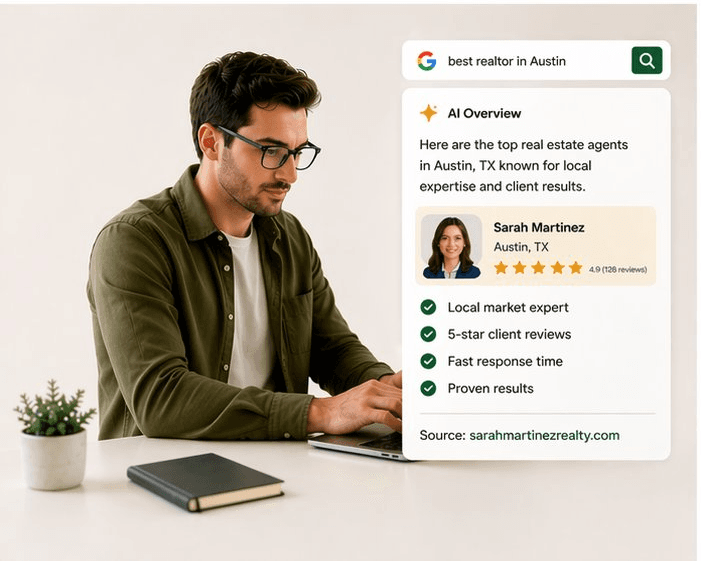
Type 1: Brokerage-provided subdomains. Franchise brokerages — Keller Williams (via Command), eXp, RE/MAX, and Coldwell Banker — offer agent websites as a membership perk. The sites are free in cash terms, but you are building on land you do not own. Google treats all agents' subdomains of the same brokerage as a template cluster. Because the underlying code, navigation, and structure are identical across thousands of agents, only the highest-authority page in the group tends to rank for competitive terms. Your personal subdomain rarely survives a search results page on its own. And as Sarah's story above illustrates, when you change brokerages, the site disappears entirely — along with every link, every review widget, and every indexed page you spent years building.
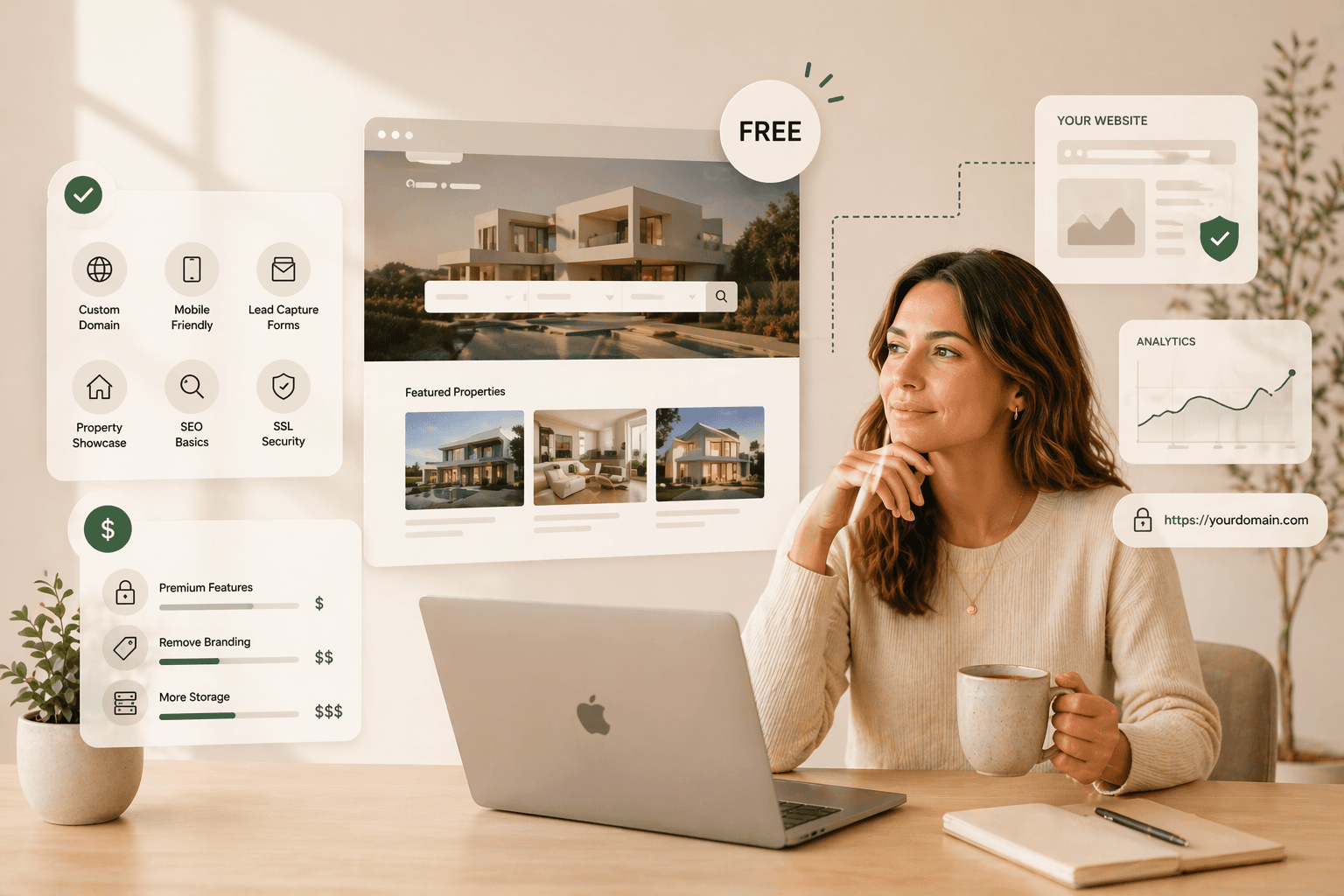
Type 2: Platform free tiers. Platforms like Placester and AgentWebsite offer a genuinely free entry plan, but these plans typically restrict the features that make a real estate website generate leads. Forced registration gates, advanced IDX map search, custom domain names, and CRM integrations are usually paywalled. Placester's free plan, for instance, does not include IDX; IDX requires a paid upgrade. The website exists, but its lead generation capability is severely limited.
Type 3: Genuinely independent free options. A small number of platforms offer real agent websites at zero cash cost with meaningful feature sets. These exist — but they typically recoup costs elsewhere (lead referral fees, upsells, or limited MLS coverage). Understanding the trade-off before you commit is the entire point of this article.
Stat: 54% of real estate agents report that their website generates zero leads for their business. — National Association of Realtors Member Profile
That 54% figure is the most important context for this entire conversation. Platform choice matters far less than whether your site has a functioning lead capture mechanism, IDX integration, and a follow-up system attached to it. A free site with all three will outperform a $500/month site with none.
What you actually get
Let's go feature by feature across the main categories. The table below is a practical reference; the detail below it explains what each feature actually means for daily business operations.
| Key Statistic / Finding | Source & Year |
|---|---|
| Custom domain (yourname.com): Brokerage subdomain ✗ (subdomain only) | Platform free tier: Usually ✗ | Independent (free/low-cost): ✓ (typically) | Feature comparison, 2026 |
| IDX / MLS listings: Brokerage subdomain ✓ (brokerage's MLS) | Platform free tier: Often ✗ or limited | Independent: ✓ (MLS fees may apply) | Feature comparison, 2026 |
| Lead capture forms: Brokerage subdomain: Basic only | Platform free tier: Basic only | Independent: ✓ | Feature comparison, 2026 |
| CRM integration: Brokerage subdomain ✗ or brokerage CRM only | Platform free tier: ✗ | Independent: Varies | Feature comparison, 2026 |
| SEO control: Brokerage subdomain: Minimal | Platform free tier: Minimal | Independent: Full | Feature comparison, 2026 |
| Portability (keep site if you move): Brokerage subdomain ✗ | Platform free tier: ✓ | Independent: ✓ | Feature comparison, 2026 |
| Blog / content publishing: Brokerage subdomain: Limited | Platform free tier: Limited | Independent: ✓ | Feature comparison, 2026 |
| You own the data: Brokerage subdomain ✗ | Platform free tier: ✓ | Independent: ✓ | Feature comparison, 2026 |
IDX access is the most commonly misunderstood element. IDX (Internet Data Exchange) is the protocol that lets your website display live MLS listings. Without it, visitors searching for homes on your site will see static pages — or nothing — and leave within seconds. The Close reports that buyers spend less than two minutes on the average real estate website; IDX search is one of the primary ways to extend that time and capture their contact information before they bounce to Zillow.
Lead data ownership is a question almost no one asks until it's too late. On a brokerage subdomain, the leads you collect belong to the brokerage's CRM, not to you personally. If you leave, the brokerage retains that database. On a platform with a free tier, you typically own the data — but check the terms of service before you commit, because some platforms claim co-ownership of lead records generated through their IDX feed.
SEO portability is the factor with the longest-term financial consequence. Domain authority — the accumulated signal that tells Google your site is trustworthy — builds over years. According to research cited by Agent Reputation, agents who leave their brokerage lose all SEO equity built on that subdomain and must restart their SEO clock from zero. For an agent who has been publishing neighbourhood guides for three years, that represents thousands of dollars of effectively destroyed content marketing investment.
One practical check: before choosing any free platform, look up whether it supports a custom domain. If your URL is yourname.brokerage.com or yourname.platform.com, you do not control your online presence — you are renting it.
Hidden costs to watch for
The sticker price of a website is rarely the actual cost. Here are the four categories where "free" real estate websites generate real expenses.
MLS pass-through fees. Even on platforms that charge nothing for the website itself, your MLS board may charge a data access fee to display its listings on your site. Showcase IDX's published pricing notes these fees vary from $0/month to $33/month depending on your board, and that 99% of IDX companies pass this cost on to the agent. Before selecting any IDX-enabled platform, look up your specific MLS board's fee schedule. In some markets this is zero; in others it is $396/year — which makes "free" meaningfully less free.
Cost range: Custom real estate website builds typically cost $5,000–$30,000 upfront and require SEO retainers of $500–$5,000 per month — costs that "free" platforms avoid entirely, at the trade-off of less design flexibility. — Luxury Presence IDX Cost Analysis, 2026
Upgrade lock-in. Platform free tiers are designed to graduate you to a paid plan once your business grows. Placester's "Do It For Me" upgrade — where their team builds and maintains your website — is a paid tier on top of the base platform. Real Geeks' entry-level Establish package is $299/month on an annual commitment, with a $500 cancellation fee if you exit early. These costs are not hidden in bad faith, but they are frequently underestimated by agents who sign up for a free trial expecting that initial pricing to hold.
Lead referral fees on "free" platforms. Some platforms offer a genuinely free website but charge a referral fee on any transaction you close through a lead the platform helped generate. This model is common in the iBuyer-adjacent space. A 25–35% referral fee on a $15,000 commission is a far larger real cost than a $150/month website subscription — and it only becomes apparent after you've already built your presence on the platform.
Domain registration after year one. Many platforms, including AgentWebsite, offer a free domain name for the first year, then charge $19/year thereafter. This is minor in isolation, but it illustrates the pattern: advertised costs typically apply to a limited introductory window, not the full lifetime of the product.
The clearest way to evaluate any free offer: map out the cost you'll actually pay at 12 months, 24 months, and at the moment you decide to switch platforms or brokerages. A free website that costs you $0 for 12 months but $8,000 in lost SEO equity and three months of rebuilt lead generation at 24 months is not actually cheap.
Pinova's free website — why it's different
Pinova's free agent website is deployed on your own custom domain, not a brokerage or platform subdomain. When you sign up, Pinova's setup process connects a lead capture form, an automated follow-up sequence, and a CRM inbox to the same account — so leads from the website land directly in a pipeline you own, rather than a brokerage database. The site goes live within 48 hours. Pinova does not charge referral fees on closed transactions generated through its platform, and it does not lock you into an annual contract on the free tier. If you upgrade or leave, your domain, your leads, and your content stay with you.
Should you start free?
Starting with a free website makes clear sense in three specific situations — and is the wrong move in one.
Start free if you're a new agent (under 12 months licensed). Your primary constraint is cash, not SEO equity — because you have no SEO equity yet to protect. A free platform with a custom domain and lead capture lets you test whether website-driven leads convert for your specific market before committing to a $299–$500/month platform subscription. The key requirement: the free platform must support a custom domain. If it doesn't, skip it entirely.
Start free if you're switching brokerages. You need a site up quickly to maintain continuity for existing clients. A free platform lets you relaunch within days while you decide on a long-term solution. Import your domain name — if you already owned one through your previous arrangement — and redirect it immediately.
Start free if you're testing a new geographic farm. Before committing to a paid IDX and SEO build in an unfamiliar market, use a free site with neighbourhood-specific landing pages to validate that organic traffic is achievable in that area. If the site generates leads within 60–90 days, invest in the full build.
Do not start free if you rely on your brokerage's subdomain. NAR data shows 90% of buyers use online resources in their home search, and buyers visit an average of 4.3 real estate websites before submitting an inquiry, per the Real Estate Standards Organization. If your only presence is a brokerage subdomain that shares template code with 10,000 other agents, you are not competing online — you are absent from search. The short-term cash saving is not worth the long-term SEO deficit.
Stat: 78% of buyers work with the first agent who responds to their inquiry — and that stat has remained consistent for five consecutive years. — NAR Profile of Home Buyers and Sellers, 2025
That 78% figure reframes the entire website cost conversation. The website's job is not to impress — it is to capture a lead and trigger an instant response. A free website that routes a form submission to your CRM and sends an automated reply within 60 seconds will outperform a $500/month site whose leads sit in an inbox until Monday morning. Start with whatever platform connects those two things fastest. Upgrade for design and SEO features once you've confirmed the lead pipeline works.
Key Statistics: Real Estate Agent Websites & Lead Conversion
| Key Statistic / Finding | Source & Year |
|---|---|
| 78% of buyers work with the first agent who responds to their inquiry | NAR Profile of Home Buyers and Sellers, 2025 |
| 90% of buyers use online resources as part of their home search process | NAR Profile of Home Buyers and Sellers, 2025 |
| 54% of real estate agents report their website generates zero leads | NAR Member Profile |
| Custom real estate website builds cost $5,000-$30,000 upfront; SEO retainers run $500-$5,000/month | Luxury Presence IDX Cost Analysis, 2026 |
| MLS pass-through fees range from $0 to $33/month depending on the agent's board; 99% of IDX providers charge them | Showcase IDX Pricing Documentation, 2026 |
| Buyers visit an average of 4.3 real estate websites before submitting an inquiry to an agent | Real Estate Standards Organization, cited in AgentZap Lead Statistics, 2026 |
| Only 26% of real estate agents have their own personal website (not provided by the brokerage) | NAR Member Profile |
| Real Geeks Establish package (website + CRM) costs $299/month on annual subscription, with a $500 early-cancellation fee | Real Estate Bees IDX Website Review, 2026 |
| 71% of buyers and 81% of sellers spoke with only one real estate professional before deciding to work with them | ListingHub Real Estate Lead Generation Statistics, 2026 |
| 43% of buyers select their agent based on a personal recommendation from a friend or neighbour | NAR Profile of Home Buyers and Sellers, 2025 |
| Listings with professional photos sell 32% faster than listings without | REsimpli Real Estate Marketing Statistics, 2025 |
| Industry-wide real estate lead conversion rates average 0.4%-1.2% from lead to signed contract | Real Geeks Coaching Data, 2024 |
Ready to put this into practice?
Pinova gives you the website, AI, CRM, and follow-up in one platform — live in 48 hours, no credit card required.
Start Your Free Trial
Frequently Asked Questions
Is a brokerage-provided website good enough for a new agent in 2026?
It depends on how long you plan to stay with that brokerage. If you're likely to remain for 5+ years and don't plan to invest in content marketing, a brokerage subdomain covers the basics. But if you intend to publish blog posts, build neighbourhood guides, or rank on Google for local search terms, you're wasting your effort — Google won't rank a templated subdomain competitively when thousands of agents share the same code. New agents who want online lead generation should start with a custom domain from day one, even on a free platform.
What does IDX cost for a real estate website in 2026?
IDX cost has two components: the platform fee and the MLS pass-through fee. Platform IDX fees range from $0/month (on some free tiers) to $50–$100/month for full-featured IDX search from providers like IDX Broker or Showcase IDX. MLS pass-through fees — charged by your MLS board directly — range from $0 to $33/month depending on your board, and apply regardless of which IDX platform you use. Before committing to any IDX platform, look up your specific MLS board's pass-through rate on the provider's MLS coverage page.
Can I use my brokerage's website and also have my own personal site?
Yes, and this is often the smartest approach. Use the brokerage subdomain for brokerage-required disclosures and listing syndication, and build your personal brand, blog, and lead capture on a separately owned domain. Make sure your personal site's terms of service comply with your brokerage's agent website policies — most franchises allow personal sites as long as they include required disclosures and don't violate brand guidelines.
What happens to my website leads if I change brokerages?
If your website is on a brokerage subdomain, your lead database typically belongs to the brokerage CRM, not to you. Leads you generated stay in the brokerage's system. If you're on an independent platform — free or paid — your leads belong to you and move with you regardless of where you hang your licence. This is one of the most financially significant distinctions between the two models, and it's worth clarifying in writing before you sign a brokerage agreement.
Do free real estate websites rank on Google?
A free website on a custom domain, with original content and proper SEO setup, can rank on Google — it simply takes longer than a paid platform with built-in SEO tools. What categorically does not rank is a brokerage subdomain with template content duplicated across thousands of agents. Google's duplicate content policy means only the highest-authority version of substantially identical pages appears in results. According to NAR data, only 2% of agents receive more than 100 leads per year from their website — partly because most agents don't invest in the content and technical SEO that drives organic traffic.
What is the real cost of a 'free' real estate website over two years?
If the free platform requires no MLS fees for your board and you stay with the same brokerage, your cash cost is genuinely $0 for 24 months. But the non-cash cost includes: zero portability if you switch firms, no domain authority you own, and no independent lead database. On an independent free platform with a custom domain and MLS pass-through fees of $20/month, your two-year cost is approximately $480 — a fraction of the $3,600–$6,000 for a mid-tier paid platform. The real decision is not cash cost; it is whether the free option supports the specific lead capture and SEO activities your growth strategy requires.
How many leads should a real estate agent website generate per month?
NAR Member Profile data shows 54% of agents get zero web leads — so the average is a misleading benchmark. Agents who publish consistent local content, have IDX search with forced or delayed registration, and respond to inquiries within five minutes report meaningfully higher capture rates. According to the Real Estate Standards Organization, buyers visit an average of 4.3 websites before submitting an inquiry, which means your site needs to give them a reason to register before they move to the next tab. Realistic expectations for a well-configured independent website: 5–20 captured leads per month in a mid-size market, depending on traffic volume and registration gate settings.
Is IDX worth it on a free or low-cost real estate website?
For buyer-facing lead generation, yes — IDX search keeps visitors on your site longer and gives you a natural registration gate. But IDX is not a traffic driver on its own. Property portals like Zillow, Realtor.com, and your local MLS portal receive far more direct traffic than individual agent sites. IDX earns its cost by converting visitors who already found you through other channels (social media, Google, referrals) rather than by attracting new visitors who were searching for listings. A well-written neighbourhood guide or home-buying FAQ will often generate more initial traffic than an MLS search widget alone.