Quick Answer
What is the best real estate website builder with IDX in 2026?
The best IDX website builder depends on your goal. For most solo agents and small teams, Real Geeks at $299/month offers the strongest all-in-one value: IDX search, CRM, automated home valuation, and Facebook ad tools in a single platform. AgentFire ($149/month) leads for brand-first SEO. Placester ($59/month + $25 IDX fee) is the best entry point for new agents. Sierra Interactive ($500+/month) is the top choice for teams prioritising organic search rankings and lead accountability.
Key Takeaways
- 43% of home buyers start their property search online before speaking to an agent, according to NAR's 2025 Profile of Home Buyers and Sellers — making your website's IDX search the first point of contact for nearly half your prospects.
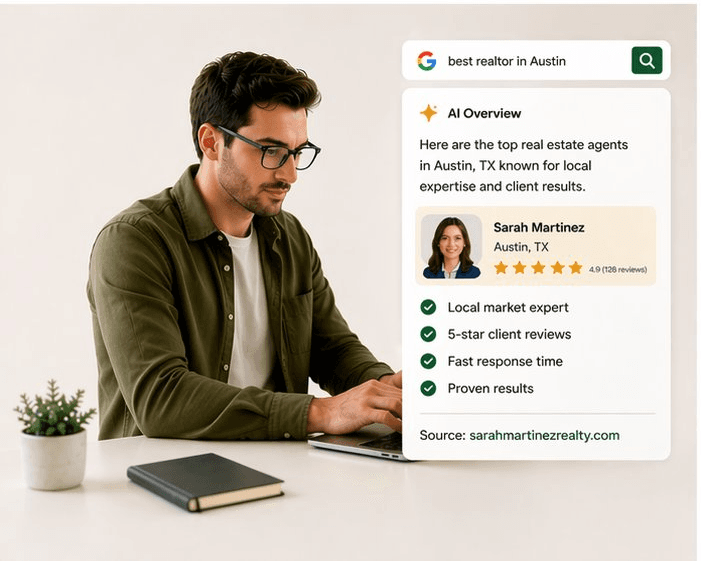
- Real estate triggers Google AI Overviews in only 5.8% of relevant searches, per Ahrefs (November 2025) — meaning agents who structure their content for AI citation have almost no competition in that channel right now.
- Budget-tier IDX platforms (Placester, AgentFire) run $80–$150/month all-in; mid-tier all-in-ones (Real Geeks) cost ~$299/month; premium team platforms (Sierra Interactive, BoomTown) start at $500–$1,000+/month.
- Forced or progressive IDX registration, home valuation tools, and neighbourhood report sign-ups are the three lead-capture mechanisms that consistently outperform a standard contact form — stack at least two on every IDX site.
- Outbound referral traffic from ChatGPT to external websites grew 206% in 2025, per Semrush — agents who publish structured, locally specific content are best positioned to receive that traffic in 2026.
Priya Mehta, an independent agent in Pune, launched her first IDX website in early 2025 using a generic template. After six months she had 1,200 monthly visitors and zero inbound leads. The IDX feed worked — buyers were searching listings — but nothing prompted them to register, no content ranked locally, and her Google Business Profile sat untouched. A competitor on the same MLS, running AgentFire with two neighbourhood guides and a home valuation widget, was pulling 8–10 lead registrations a month from half her traffic. The difference was not the IDX. It was everything built around it.
This guide covers the six platforms worth evaluating in 2026 — with real pricing, honest trade-offs, and the lead-capture and AI-search tactics that separate sites that generate commissions from sites that just display listings. By the end you will know which platform fits your budget and goal, and exactly what to build on day one.
Why your agent website matters more in 2026
The home search begins online — not "usually" or "often", but universally. NAR's 2025 Profile of Home Buyers and Sellers, based on surveys of buyers who closed between July 2024 and June 2025, found that every single buyer used online resources at some point in the search process, with 43% saying their very first step was looking for properties online. That figure has held between 43–47% for five consecutive years.
What has changed is where that search happens and what it costs to miss it. Google AI Overviews now appear in more than 50% of all searches, according to Ahrefs. For real estate specifically, those AI summaries still trigger on only 5.8% of relevant queries — a low floor that is rising as Google's Gemini 2.0 expands its local content coverage. Agents who build content-rich, structured websites today are setting up visibility in an AI channel that currently has almost no competition.
The second shift is lead quality. NAR's 2025 data shows 88% of buyers still used a real estate agent to close — but 43% found their agent through a referral, and another 18% returned to an agent they'd worked with before. That means only about 39% of buyers actively discovered a new agent. Your website is your primary discovery tool for that segment, and an IDX site with no lead capture, no local content, and no AI-ready structure is invisible to them.
Stat: 43% of buyers started their home search online before contacting any agent, a figure that has held steady across five consecutive NAR annual surveys. — NAR 2025 Profile of Home Buyers and Sellers
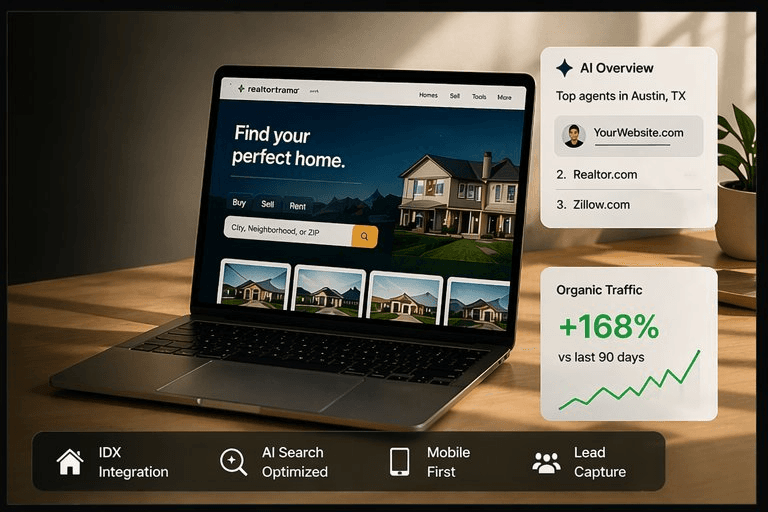
A website without IDX sends buyers to Zillow to search — and Zillow sells their information to three competing agents. A website with IDX, progressive registration, and a home valuation widget keeps the buyer in your ecosystem. The platform you choose determines whether you capture that lead or donate it.
What to look for in an IDX website builder
Four features are non-negotiable before you evaluate anything else. Miss any one and no amount of design quality or AI tooling recovers the gap.
Live, reliable IDX feed. The major IDX providers — IDX Broker, iHomefinder, Showcase IDX — all meet this standard. What separates them is how cleanly they integrate with the builder you choose. If you are on Real Geeks or Sierra Interactive, IDX is built in and requires no additional setup. On WordPress, IDX Broker and iHomefinder are the dominant standards. Before committing to any platform, sit on the site as if you were a buyer: click through five listings, see what triggers a registration prompt. If nothing does, fix that before you spend money on traffic.
Lead capture beyond the contact form. A contact form alone captures fewer than 2% of visitors. The features that move the needle are forced or progressive IDX registration (ask for email after the third or fourth search), a home valuation tool (CMA generator), neighbourhood report sign-ups, and exit-intent popups. Stack three or more — never rely on one. Real Geeks includes automated home valuation out of the box; AgentFire's Spark AI content tool generates neighbourhood pages that act as organic lead-capture surfaces.
SEO foundations. Clean URL structure, editable meta titles and descriptions per page, schema markup for listings, fast mobile load times (under 3 seconds), and a blog with proper H-tag hierarchy. If you cannot edit the meta title on each listing page individually, you cannot rank for specific address or neighbourhood queries. Walk away from any platform that locks this.
CRM integration with near-zero lead lag. A captured lead with no follow-up is a wasted lead. Either the platform includes a CRM (Real Geeks, Sierra Interactive) or it connects cleanly to the one you already use (Follow Up Boss, HubSpot, kvCORE). Lead-to-CRM lag should be measured in seconds — every minute of delay drops your odds of qualifying that lead. Agents who build on a platform where the website and CRM are separate systems and not synced in real time lose a measurable share of conversions every month.
Checklist: Before signing up for any IDX platform, verify these four items: (1) Can you edit the meta title per listing page? (2) Does the platform trigger a registration prompt automatically after a set number of searches? (3) What is the CRM integration — native or third-party? (4) What is the mobile load time on a sample listing page?
Top website builders compared
Six platforms represent the realistic decision set for most agents in 2026. Here is what each actually does, what it costs, and who it is for.
Real Geeks — Best all-in-one value ($299/month)
Real Geeks is the most frequently recommended all-in-one platform for agents and small teams who want IDX, CRM, and marketing tools without enterprise pricing. At $299/month (plus a $250 setup fee), it includes IDX search, a built-in CRM with AI lead scoring, automated home valuation, Facebook ad management, SMS and email drip campaigns, and market reports. Lead behaviour on the site — searches, saved listings, price-change alerts — flows directly into the CRM without integration work. The platform is used by over 7,000 agents and teams. Its weakness is design: listing pages are functional but require manual customisation to differentiate your brand, and the CRM interface, while capable, has a steeper learning curve than newer platforms.
AgentFire — Best for SEO and local brand ($149/month + $600 setup)
AgentFire builds on WordPress, meaning you own your site outright — a meaningful advantage if you ever switch brokerages or tools. Its Spark AI content tool generates neighbourhood guides and blog posts, which are the most effective long-term SEO assets a real estate website can hold. Two neighbourhood pages per month for 12 months will outperform most paid lead sources on a per-dollar basis once they begin ranking. IDX is included but runs on pass-through MLS fees depending on your market. AgentFire integrates cleanly with Follow Up Boss, which is the CRM most high-producing independent teams run. It is not an all-in-one system — you will need a separate CRM — but for agents whose growth strategy is organic search and local authority, it is the strongest platform in its category.
Sierra Interactive — Best for teams with SEO goals ($500–$1,500/month)
Sierra Interactive's core advantage is SEO-first architecture. Where most platforms rely on paid ads to generate leads, Sierra's sites are built to rank organically — fast mobile load times, clean URL structures, and structured data on listing pages out of the box. Its CRM includes a built-in auto-dialer, SMS/MMS, AI-powered texting assistant, and 90+ integrations, making it the strongest choice for teams that want lead routing, agent accountability, and structured follow-up workflows. Pricing starts at $524.95/month for up to five users. Teams of 3–20 agents who want to reduce dependence on paid advertising will see the strongest ROI from Sierra over a 12–24 month horizon.
Placester — Best budget entry ($59/month + $25 IDX)
Placester is where agents who need a working IDX site fast and inexpensively should start. At $59/month for the Agent Essentials plan plus a $25 IDX fee, it includes drag-and-drop editing, a template library, IDX integration, basic lead capture, and a simple CRM with autoresponders and email drip campaigns. Its weakness at the entry tier is limited lead monitoring — you cannot see which properties a registered lead viewed, which removes a valuable behaviour signal from your follow-up. The $119/month Do-It-For-Me plan solves most of this. More than 25,000 agents use Placester. It is not the platform you build a content strategy on, but it is a legitimate first site for a new agent with a limited budget.
kvCORE / BoldTrail — Best for brokerages (from $499/month)
kvCORE, now rebranded as BoldTrail, is the standard enterprise platform for brokerages managing multiple agents. It combines configurable IDX websites, an AI-assisted CRM, and "Marketing Autopilot" — a multi-channel follow-up automation layer — under a single vendor. Pricing starts at $499/month for two users and rises to $1,800/year for 51–100 users. Its interface is notoriously complex, and the learning curve is steep for new agents. If you are a solo agent or a team of fewer than five, BoldTrail is more platform than you need. For brokerages with enterprise governance requirements, lead routing, and branding consistency across a large team, it remains the most capable option.
BoomTown — Best for PPC-driven teams ($1,000+/month)
BoomTown pairs an IDX website with a predictive CRM whose "Opportunity Wall" surfaces the contacts most likely to transact next. Its primary model is paid advertising — the platform is designed for teams that invest in Google and Facebook ads and need structured lead routing, accountability dashboards, and concierge services. Teams typically report costs of $1,000–$2,000+/month. BoomTown does not publish pricing publicly. For organic SEO, Sierra Interactive consistently outperforms it. For teams whose growth strategy is PPC and who need tight CRM workflow discipline, BoomTown remains an established choice — but the annual contracts and setup fees position it firmly for established operations, not new agents.
The free option most agents don't know about
Many large franchise brokerages offer free IDX websites as a standard agent benefit. Keller Williams agents get a KW Command-powered site with IDX included. Douglas Elliman and similar firms offer branded agent subsites with MLS feeds. These sites cost nothing and can go live in days.
The catch is ownership. When you leave the brokerage, you lose the site, its content, its backlinks, and its search rankings — everything built on it. You cannot port the domain, the blog posts, the neighbourhood guides, or the lead history. Five years of SEO equity disappears.
A second free-tier option exists through self-hosted WordPress. The WPResidence theme costs roughly $79 one-time, shared hosting runs $10–$30/month, and an IDX plugin (IDX Broker, iHomefinder) adds $50–$150/month. Total first-year cost is typically $500–$2,500 depending on IDX, hosting, and any developer time. Compare that to Real Geeks at roughly $4,800/year — you own the asset permanently on WordPress, and your long-term costs level off while subscription fees do not. The trade-off is setup complexity: a non-technical agent will need 40–60 hours of DIY setup time or a freelance developer for the initial build.
Decision rule: Use your brokerage's free IDX site only if you are in your first year, testing the market, or certain you will stay at that brokerage for life. For any agent building a long-term independent brand, own your site from day one — the equity is non-transferable otherwise.
The middle path is Pinova, which bundles an agent website, IDX integration, AI-powered CRM, and automated follow-up into a single platform that goes live in 48 hours. Unlike brokerage subsites, you own the domain and the lead data, and unlike a WordPress self-build, there is no technical setup required.
Optimising for AI search in 2026
Real estate sits at the bottom of every major AI visibility ranking — and that is an opportunity, not a problem. Ahrefs data from November 2025 shows AI Overviews trigger on only 5.8% of real estate searches, the second-lowest rate of any major industry. A separate April 2026 study by 5WPR and Haute Residence put the AI Overview trigger rate for real estate even lower, at 0.14%, when looking specifically at agent-level queries. Either way, the competitive bar in AI search for real estate is almost nonexistent right now.
The strategic implication is simple: agents who publish structured, locally specific content in 2026 are building AI visibility with almost no competition. Nearly 31% of the US population will use generative AI search in 2026, according to EMARKETER, and outbound referral traffic from ChatGPT to the open web grew 206% in 2025 per Semrush. The audience is moving fast.
Three tactics drive AI visibility for real estate websites specifically:
1. Hyperlocal neighbourhood pages with FAQ sections. AI Overviews and ChatGPT pull heavily from pages that answer specific questions directly — "What are closing costs in [city]?", "What are the best neighbourhoods in [city] for first-time buyers?". A dedicated page per neighbourhood with a 5–8 question FAQ structured in plain, declarative prose gives AI systems clean, extractable content. AgentFire's Spark AI tool generates these at scale; on any other platform you write them manually, but two per month for 12 months compounds into a durable moat.
2. Consistent entity and authority signals. AI tools verify local experts through Google Business Profile data, NAP consistency (name, address, phone across your website and all directories), and author attribution on published content. Update your GBP weekly with posts, photos, and responses to reviews. Publish every blog article under a real author byline with credentials — not "Pinova AI Research Team." Research from Growth Memo (February 2026) found that 44.2% of all LLM citations come from the first 30% of an article's text, which means your introduction needs to answer the question directly, not build to it.
3. Structured data (schema markup) on all key pages. Article schema for blog posts, LocalBusiness schema on your contact/about page, FAQ schema on neighbourhood pages, and RealEstateListing schema where supported by your IDX platform. This is not primarily a ranking tactic — it is how AI systems confirm your site is authoritative on a specific topic and geography. Sierra Interactive and AgentFire both implement schema automatically; on WordPress self-builds, the Rank Math or Yoast plugins handle this in minutes.
Stat: AI Overviews now appear in over 50% of all Google searches, but trigger on only 5.8% of real estate queries — meaning the first agents to build AI-structured content in their market will face almost no competition in that channel. — Ahrefs, November 2025
Which builder wins
The right platform is the one your team will actually use — but the decision narrows quickly once you match platform to goal.
If you are a new or solo agent with a budget under $150/month: start with Placester. You get a working IDX site, basic lead capture, and a CRM for under $85/month all-in. It is not where you finish, but it is a legitimate starting point that does not lock you into a long contract.
If you are building a long-term organic lead machine as a solo agent or small team: AgentFire is the strongest choice. Its WordPress foundation means you own every piece of content, and its Spark AI tool makes neighbourhood page creation fast. Pair it with Follow Up Boss for CRM. Budget roughly $200–$250/month including IDX.
If you want IDX, CRM, and automation in one system without integration headaches: Real Geeks at $299/month is the best value in the all-in-one category. Lead behaviour flows from site to CRM automatically, and the platform's AI lead scoring helps you prioritise follow-up without manual review.
If you lead a team of 3–20 agents and your goal is organic SEO plus structured accountability: Sierra Interactive. The higher price ($500+/month) pays for built-in dialer, SMS/MMS, 90+ integrations, and a site architecture that outranks PPC-dependent competitors over a 12–24 month horizon.
If you run a brokerage: BoldTrail (kvCORE) or BoomTown depending on whether your growth model is organic or paid-ad driven, respectively. Both require significant investment and long onboarding cycles — budget 60–90 days before the system is fully operational.
Whatever platform you choose, the decision that will determine your lead volume over the next 24 months is not the platform itself — it is whether you publish two neighbourhood-specific content pieces per month and maintain a clean Google Business Profile. Agents doing that on Placester outperform agents on Sierra Interactive who post nothing. The platform is the foundation. The content is the engine.
Key Statistics: Real Estate Websites and AI Search in 2026
| Key Statistic / Finding | Source & Year |
|---|---|
| 43% of buyers started their home search online before any other step, a figure consistent across five consecutive annual surveys | NAR 2025 Profile of Home Buyers and Sellers |
| 88% of buyers purchased their home through a real estate agent or broker | NAR 2025 Profile of Home Buyers and Sellers |
| 91% of sellers used a real estate agent — the highest share ever recorded | NAR 2025 Profile of Home Buyers and Sellers |
| Real estate AI Overviews trigger rate is 5.8% — the second-lowest of any major industry | Ahrefs, November 2025 |
| AI Overviews now appear in 50%+ of all Google searches | Ahrefs / SingleGrain analysis, 2026 |
| Outbound referral traffic from ChatGPT to external websites grew 206% in 2025 | Semrush, April 2026 |
| 31.3% of the US population will use generative AI search in 2026 | EMARKETER forecast, 2026 |
| 44.2% of all LLM citations come from the first 30% of article text (the introduction) | Growth Memo, February 2026 |
| Agent website budget tier (Placester, Easy Agent PRO) runs $80–$150/month including IDX | HousingWire / jamilacademy.com best |
| Real Geeks all-in-one platform is used by over 7,000 agents and teams at ~$299/month | Real Geeks / HousingWire |
| Sierra Interactive Core Package starts at $524.95/month for up to five users | HousingWire best website builders for real estate, March 2026 |
| BoomTown teams typically report costs of $1,000–$2,000+/month; pricing is quote-based | Dewx BoomTown alternatives analysis, 2026 |
Ready to put this into practice?
Pinova gives you the website, AI, CRM, and follow-up in one platform — live in 48 hours, no credit card required.
Start Your Free Trial
Frequently Asked Questions
What is IDX and why does a real estate agent need it?
IDX (Internet Data Exchange) is a system that allows real estate agents to display live MLS listing data on their own website. Without IDX, your site shows only your own listings — buyers searching for homes in your market leave for Zillow or Realtor.com and their contact information goes to whoever pays for leads there. With IDX, buyers search on your site, register to save searches, and their lead data comes directly to you. It is the single most important feature on any agent website.
How much should I spend on a real estate website with IDX in 2026?
A solo agent can expect to spend $80–$150/month at the budget tier (Placester, Easy Agent PRO), $200–$300/month at mid-tier (Real Geeks, AgentFire), and $300–$600+/month at the premium tier (Sierra Interactive, Luxury Presence). Teams and brokerages should budget $500–$2,000+/month for enterprise platforms like BoldTrail or BoomTown. A self-hosted WordPress build with IDX plugin costs $500–$2,500 in year one but levels off significantly after that.
Is Real Geeks or AgentFire better for a solo agent?
It depends on your strategy. Real Geeks gives you an all-in-one system — IDX, CRM, home valuation, and automation — at $299/month with no need to manage integrations. AgentFire ($149/month plus setup) is the stronger choice if your growth model is organic content and local SEO: you own the WordPress-based site, and the Spark AI content tool generates neighbourhood pages that compound over time. If you want simplicity and speed, Real Geeks. If you want long-term SEO ownership, AgentFire.
Will my brokerage's free IDX website work, or do I need my own?
A brokerage-provided IDX website works for generating leads while you are at that brokerage, but you own nothing — no domain, no content, no lead history, no search rankings. When you leave, everything resets to zero. Any agent building an independent long-term brand should own their own domain and site from day one. A self-hosted WordPress site with IDX costs under $200/month and travels with you regardless of where you work.
How do I get my real estate website to show up in ChatGPT or Google AI Overviews?
Real estate triggers AI Overviews in only 5.8% of searches, according to Ahrefs — meaning competition in AI search is nearly nonexistent right now. Three tactics work: publish hyperlocal neighbourhood pages with embedded FAQ sections answering the specific questions buyers type into AI tools, maintain consistent NAP (name, address, phone) across your site and Google Business Profile, and use schema markup (Article, FAQ, LocalBusiness) so AI systems can verify your authority. Two neighbourhood-focused pages per month for 12 months builds compounding AI and organic visibility.
What lead capture features should every real estate IDX site have?
Beyond a basic contact form, the features that consistently generate leads are: forced or progressive IDX registration (prompts buyers to register after viewing three to five listings), an automated home valuation tool, neighbourhood market report sign-ups, and an exit-intent popup for returning visitors. Platforms like Real Geeks include all four natively. On AgentFire or Placester, some are add-ons. Stack at least three of these — a site relying on a single contact form will not capture more than 1–2% of its visitors.
Is Sierra Interactive worth the higher price for a small team?
For a team of three to ten agents whose growth strategy is organic SEO rather than paid ads, yes. Sierra Interactive's site architecture is built to rank in search engines, and its built-in CRM includes a dialer, SMS/MMS, and lead routing that eliminate the need for separate tools. The $500+/month price includes capabilities that would cost $800–$1,200/month if assembled from separate vendors. For a solo agent or anyone relying primarily on paid advertising, the premium is harder to justify — Real Geeks delivers better value at that scale.
How long does it take for an IDX website to generate consistent leads?
Paid traffic (Facebook ads, Google PPC) can generate leads within the first week if your registration prompts are configured correctly. Organic SEO typically begins producing consistent inbound leads between months 9 and 18, depending on how frequently you publish local content. Agents publishing two neighbourhood-focused pages per month see meaningful ranking gains within 12 months, according to SEO practitioners who track real estate sites specifically. The fastest path to organic leads is Google Business Profile optimisation — a complete, regularly updated GBP can drive inbound calls within 30 days, at no cost beyond your time.
📚 Related Reading
- Free real estate agent website in 2026: what you actually get (and what it costs later)
- How to build a real estate website that ranks on Google AI Overviews in 2026
- How to use AI to respond to every real estate inquiry in under 60 seconds
- How to automate your real estate follow-up without sounding like a robot